
Prefabricated buildings aren’t some futuristic invention—they’re just buildings made from factory-built components, shipped to site, and pieced together like a giant 3D puzzle. And guess what? It’s not new. The Romans were at it centuries ago, using prefab methods for their military camps. Fast forward to today, and the concept is making a serious comeback—only now, it’s less about marching legions and more about smarter, faster, and more efficient construction.
Modular construction in Victorian Britain.
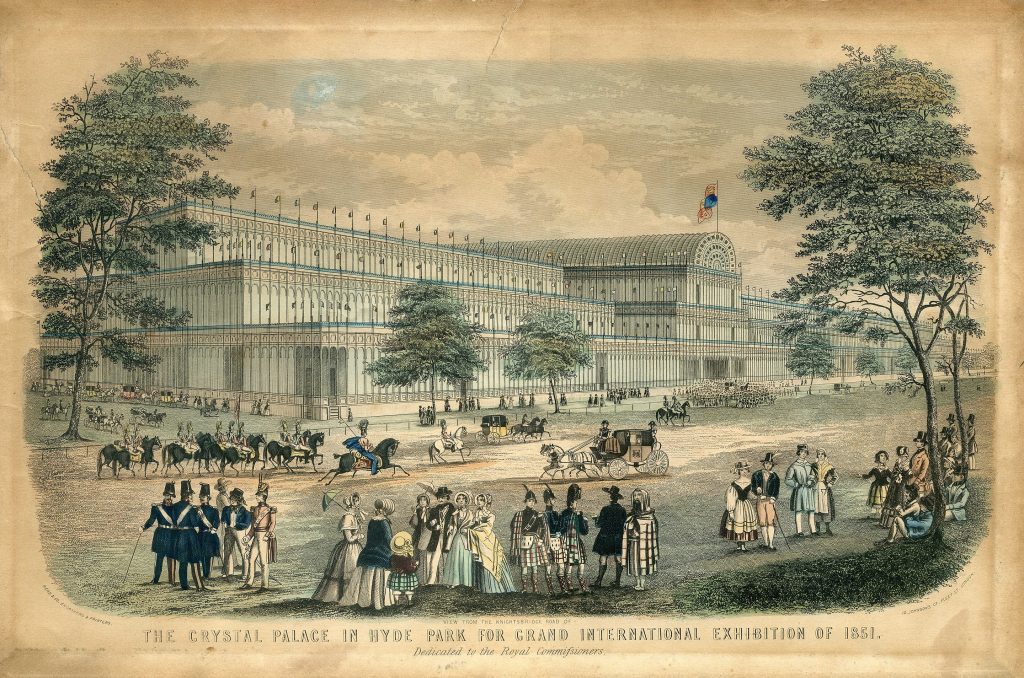
An beautiful example of modular construction being showcased in Britain was the Great Exhibition in 1851, a grand cast iron and glass structure originally built in Hyde park. The historical significance of this Exhibition, the brain child of Prince Albert, on the culture of public education in Britain cannot be ignored, but that is a story for another article.
The geometry of the palace was specifically designed to utilise standard glazed panel sizes and so the building’s exterior could be built using identical panes, thereby drastically reducing both their production cost and the time needed to install them. This type of construction was new and perfectly embodied the spirit of British industrial innovation.
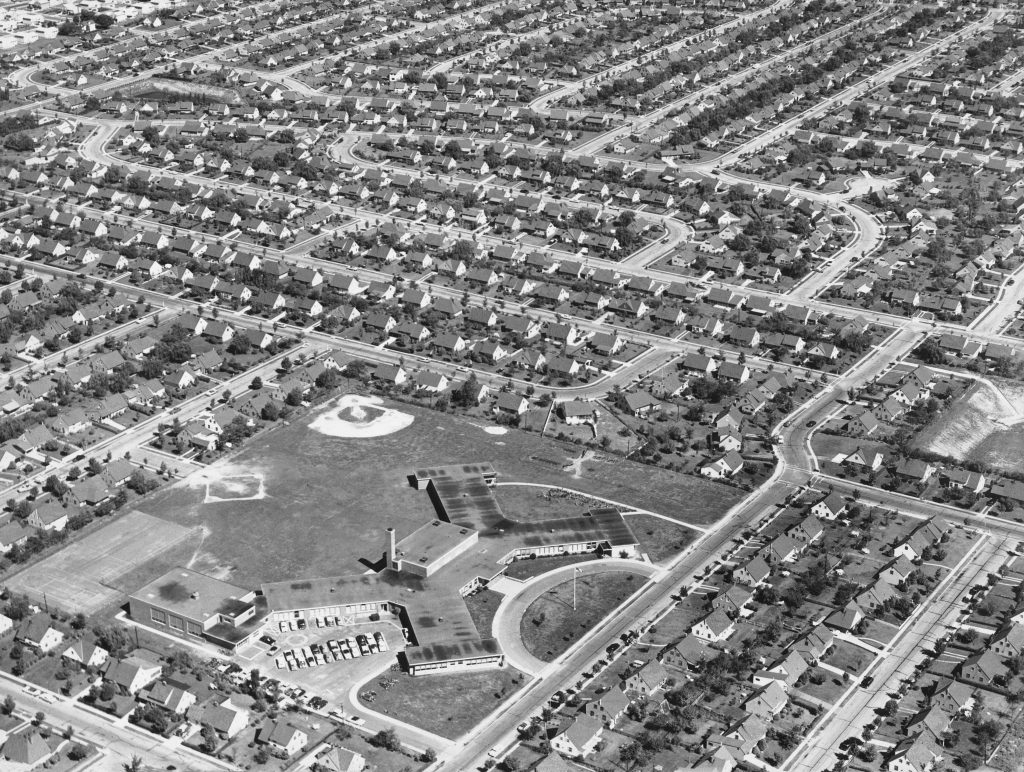
Post war-housing : Levittown New York
After World War II, countries needed to build more housing quickly to deal with the inevitable baby boom of the 1950s. Industrial scale manufacturing was essential during war time, and building firm Levitt and Sons diverted the new assembly lines and techniques to building Levittown New York. A new community of prefabricated low cost housing. With these methods, they were able to build 30 single story homes a day. The town has been labelled Americans first suburb. The UK saw a similar turn to low cost pre fabrication in the years following the war. Although these houses did push the construction industry’s innovation, their relatively poor quality has given the name “pre-fab housing” bad connotations.
A solution to the UK Housing Crisis
Modular construction has been noted as a potential solution for the UK’s current housing crisis. Modular construction for housing is extremely popular in places such as Japan, Sweden and Germany. Although, in the UK there is still a stigma of modular construction resembling the low-cost, poor quality pre-fab housing which was erected after WW2.
But in reality, there is no reason for these homes to be poor quality simply because they are built off-site. People generally think of the process’ efficiency and cost saving capabilities. However, there is also a benefit to building elements being built and assembled in protected factory conditions rather than being exposed to the elements. Prefab building sites require less individual deliveries from different suppliers, reducing costs, potential delays, air pollution and carbon footprint. There is also the added benefits for the local residents who have to deal with less air and noise pollution.
Modular constructions is becoming more and more attainable with the development of technology. As architects, we are beginning to harness the power of BIM where we are using a component based technology to design. Programmes such as Revit work on the idea of using a catalogue of products and assembling these into a virtual 3D form in order to create our drawings. It would almost seem like we are applying the concept of prefabrication to the design process. Further developments in manufacturing such as 3D printing will enable these building components to be created in even more places, reducing the need to for the long distance haulage of parts.
Some beautiful examples of Prefabricated Buildings:
Moliving have designed these hotel pods which can be easily built and moved to site. The idea is that these pods can be moved elsewhere depending on the hotels demand for rooms, without leaving a trace. Modular fabrication company SG Blocks have used old shipping containers as the shell for these nomadic rooms. Moliving will open first “nomadic hotel” in New York’s Hudson Valley
Mexican firm, Amezcua, have designed this weekend retreat using the kineki system. A timber frame houses pre built modular units. Multiple units can be joined together to make larger rooms. The simplicity of the structure with all the exposed timber is beautiful. Amezcua unveils homes built using its prefabricated Kineki system
Rogers and Partners were one of the pioneers in using this type of construction. Architecture Step by Step: Y:Cube by Rogers Stirk Harbour + Partners – Architizer Journal
Prefabrication: The Innovation Our Industry Needs (But Not the Only Fix)
Prefabrication isn’t the enemy of good design—it might just be its secret weapon. Sure, the word “standardisation” makes some designers break out in hives, but let’s be real: BIM and off-site construction are here to stay, and they don’t have to kill creativity. In fact, some of the best-designed buildings out there prove otherwise.
Think about it—you wouldn’t want your car assembled in a muddy field, so why should your home be any different? The real challenge isn’t the method; it’s getting the UK’s infrastructure up to speed before Europe and beyond leave us in the dust. If we’re shipping in prefabricated components from overseas, we’re losing out on both economic benefits and carbon savings.
And while prefab can help tackle the housing crisis, it’s no silver bullet. Land prices, power structures, and the desperate need for social housing still need fixing. That said, as architects, we can start small—researching suppliers, adapting our designs to standardised systems, and learning from those already doing it. Prefabrication won’t solve everything, but it could be the jolt of innovation our outdated construction industry desperately needs.